
Note
Go to the end to download the full example code.
Field-of-View Controls#
This example demonstrates two complementary properties for controlling the observer’s field of view (FOV):
observer_los_view— specify the FOV as explicit helioprojective angular extents(x0, x1, y0, y1)in degrees.observer_fov_view— specify the FOV by the minimum line-of-sight impact radius \(r_\mathrm{min}\) in \(R_\odot\).
Both setters update the camera’s view angle and focal point simultaneously.
observer_position must be set
before either FOV property, because the focal-point calculation depends on
the observer distance.
Coronagraph View via Angular Extents#
observer_los_view accepts a
4-tuple (x0, x1, y0, y1) of helioprojective angular extents in degrees.
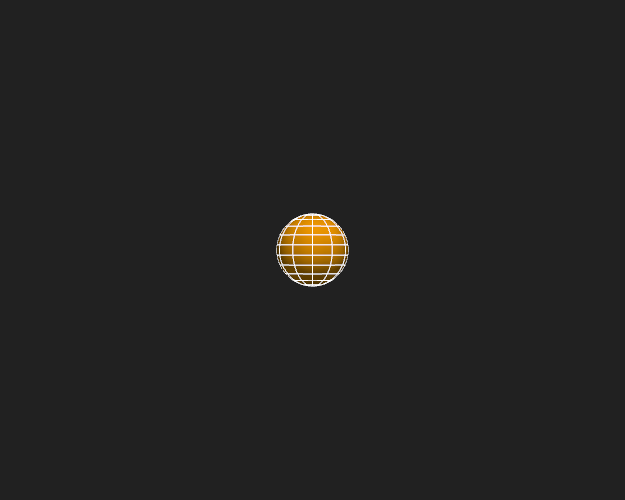
Here we simulate a coronagraph at \(r = 50\,R_\odot\) on the
equatorial plane with a \(\pm 10°\) horizontal by \(\pm 8°\)
vertical FOV centered on the Sun.
plotter = Plot3d(off_screen=True, window_size=(500, 500))
plotter.add_sun()
plotter.add_longlat_lines()
plotter.observer_position = 50, pi / 2, 0
plotter.observer_los_view = -10, 10, -8, 8
plotter.show()
Coronagraph View via Impact Radius#
observer_fov_view expresses the
FOV in physical units: the setter computes the symmetric half-angle
\(\alpha = \arcsin(r_\mathrm{min} / d_\mathrm{obs})\) and forwards it
to observer_los_view as
\((-\alpha, +\alpha, -\alpha, +\alpha)\).
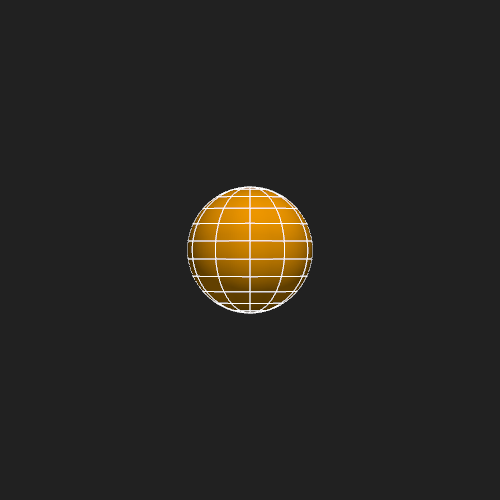
Setting \(r_\mathrm{min} = 4\,R_\odot\) sizes the FOV so that the outermost lines of sight just graze the corona at 4 solar radii — a natural choice for an instrument designed to observe mid-corona dynamics.
plotter = Plot3d(off_screen=True, window_size=(500, 500))
plotter.add_sun()
plotter.add_longlat_lines()
plotter.observer_position = 50, pi / 2, 0
plotter.observer_fov_view = 4
plotter.show()
Total running time of the script: (0 minutes 0.984 seconds)