
Note
Go to the end to download the full example code.
2-D Surface Slices#
This example demonstrates add_2d_slice()
— the method for rendering a 2-D surface at a fixed spherical coordinate.
Exactly one of r, t, p must be a size-1 array, pinning that
coordinate. The other two axes define the surface grid. The fixed axis is
inferred automatically, and the result is rendered as a quad-faced surface
colored by the supplied data array.
The three fundamental 2-D slice orientations in spherical geometry are the
radial shell (fixed \(r\)), the theta cut (fixed \(\theta\)), and
the phi cut (fixed \(\phi\)). Each is produced here by passing a single
integer index for the pinned dimension to
read_hdf_by_index(); None selects the full extent of the
remaining two axes.
from psi_io import read_hdf_by_index
from pyvisual import Plot3d
from pyvisual.utils.data import fetch_datasets
Radial Shell#
Fix \(r = r_1 \approx 1\,R_\odot\) and vary both \(\theta\) and \(\phi\) over their full extents. The resulting surface is a spherical shell at the inner coronal boundary, colored by the radial magnetic field \(B_r\) — the photospheric boundary condition for the MAS coronal model.

Theta Cut (Equatorial Plane)#
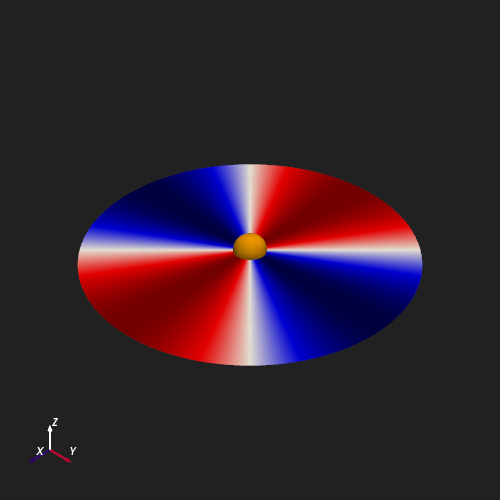
Fix the colatitude at the equatorial plane (\(\theta = \theta_{71} \approx \pi/2\)) and vary both \(r\) and \(\phi\) over their full extents. The surface is colored by the signed radial magnetic flux \(B_r r^2\), which removes the geometric \(1/r^2\) falloff and highlights the longitudinal structure of open-field regions at all distances from \(1\) to \(30\,R_\odot\).
Phi Cut (Meridional Plane)#
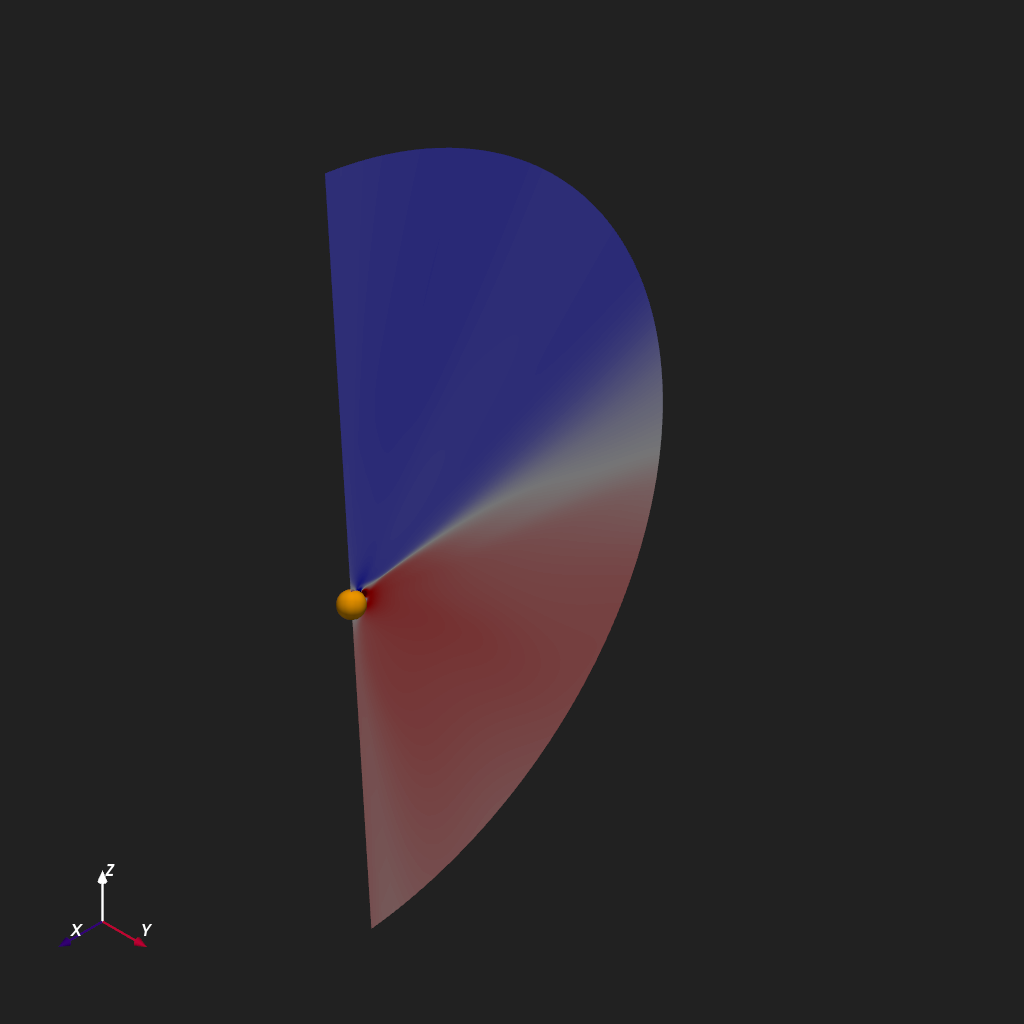
Fix the longitude at a mid-grid meridian (\(\phi = \phi_{149}\)) and vary both \(r\) and \(\theta\) over their full extents. The resulting surface is a meridional plane that cuts through the full coronal domain, showing the latitudinal and radial structure of \(B_r\) from the solar surface to the outer boundary.
Total running time of the script: (0 minutes 2.085 seconds)